

Sidepiece guide
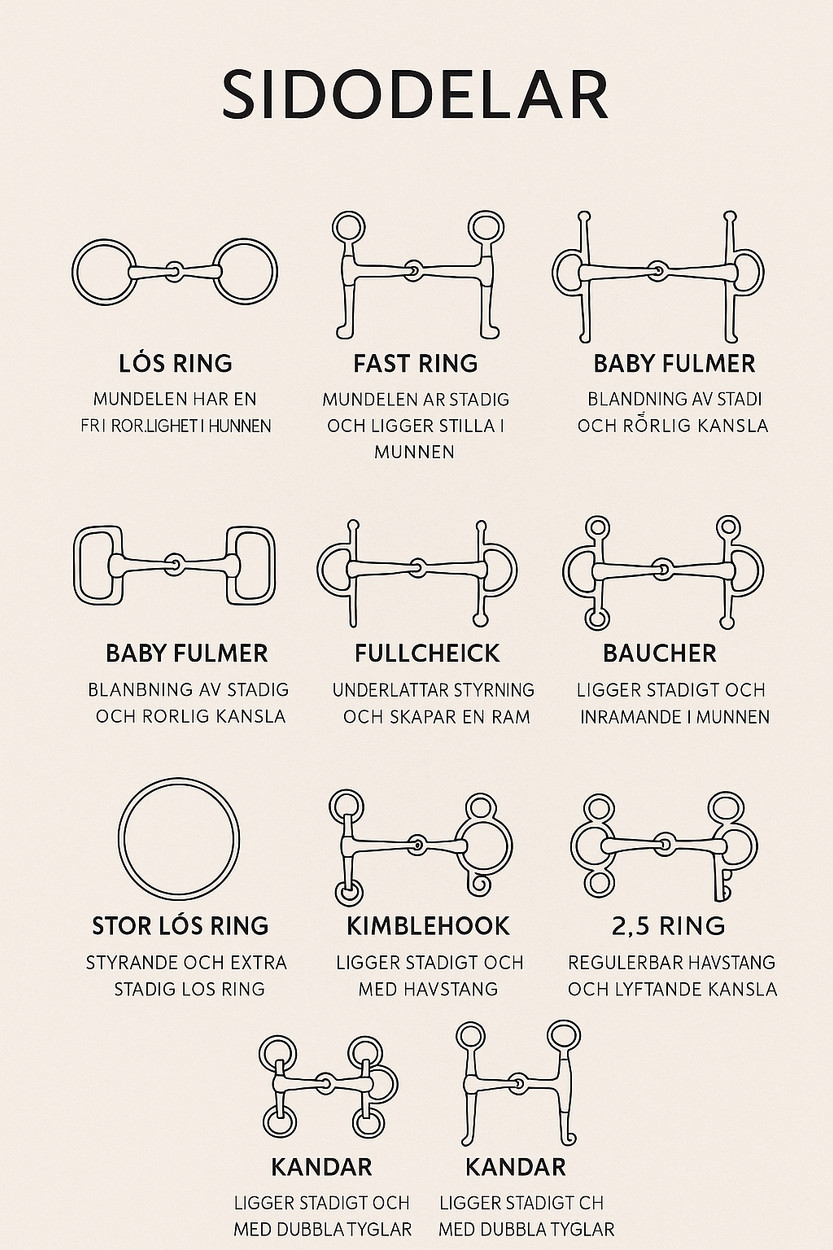
Loose rings – Allow the horse to position the bit in its mouth and create a mobile, free feeling. Suitable for horses that easily become numb or heavy in the hand.
Fixed rings (Eggbutt) – Create a stable and clear contact. Good for horses that need help with framing or become anxious with too much movement.
D-rings – Sit firmly in the mouth and provide support for steering. The straight sides help to frame the horse.
Mini Fullcheek – A combination of loose rings and small cheekpieces that provide both flexibility and framing. Approved for dressage.
Fullcheek – The cheekpieces prevent the bit from sliding sideways and provide clear framing, particularly useful for training young horses.
Large loose rings – A variant of loose rings with more surface area, which provides some stability but maintains flexibility.
Baucher – Provides a slight lift in the front part and a stable feeling. Especially good for horses with sensitive corners of the mouth or cheek teeth.
Kimblehook – A fixed construction with the possibility of some leverage. Can help with strong or anxious horses.
2.5 rings – The placement of the reins determines how much leverage effect you get. Provides adjustable contact and is useful on hot or pull-heavy horses.
Beval – A mild variant of universal bits. The ring's recessed construction provides a softer feeling with some flexibility.
Pelham – Provides clear framing and the possibility of varying leverage, depending on rein placement. Used with two reins or a double rein.
Butterfly – Similar to a Baucher with leverage, often used in driving. Provides both control and compliance.
Double bridle – A combination of a curb and bridoon with two reins. Provides great variation in leverage effect and is standard in classical dressage at higher levels.